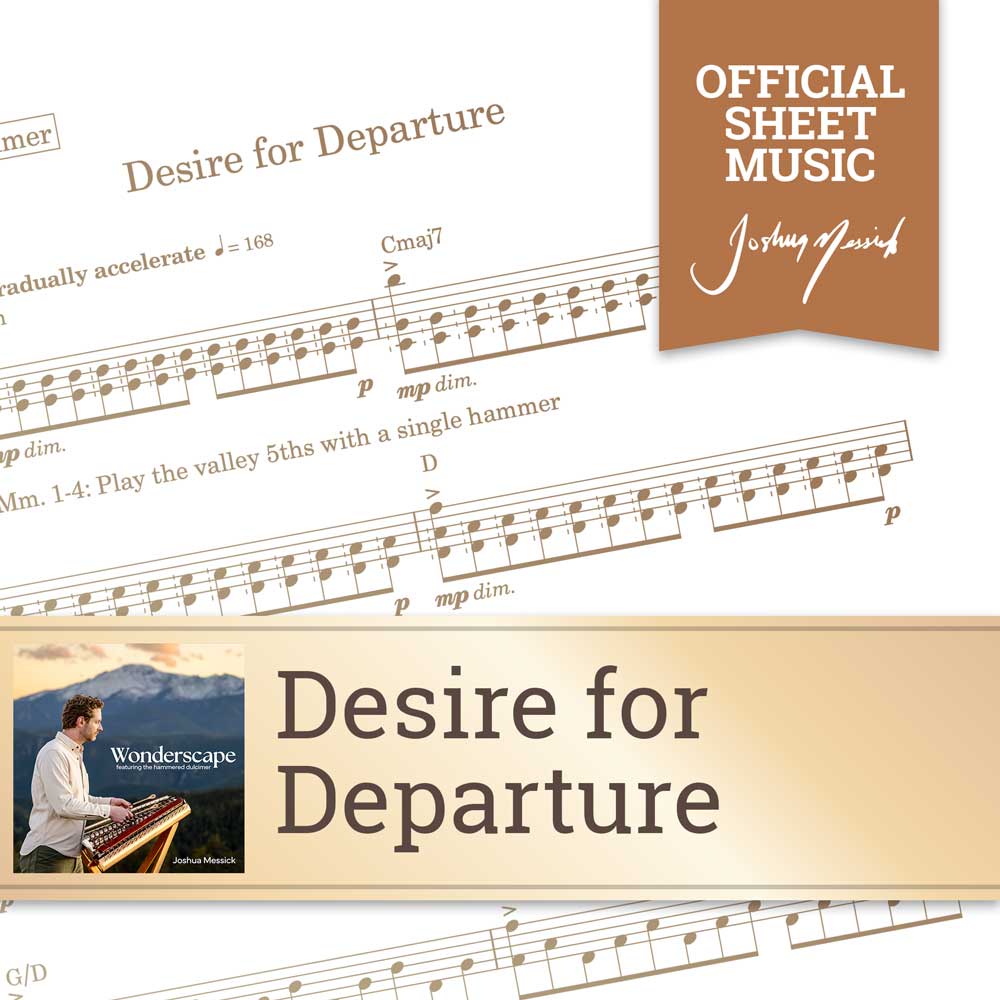
This piece was originally the title track of my 2008 release. Over the years, it has evolved, and in 2024, I re-recorded it as a solo version featured on my album Wonderscape. The accompanying sheet music reflects this solo version as it appears on Wonderscape.
You can find a solo performance of this piece on my YouTube channel, which serves as a valuable learning resource. Observing my sticking and mapping techniques—elements that cannot be fully captured through music notation—may be particularly helpful.
I have made every effort to notate this piece clearly and logically. While there may be subtle differences from the album version, the notation remains very close to the recording.
When I perform this piece, I incorporate elements of improvisation, and I encourage you to do the same by adding your own interpretations. For instance, I play the double-stroke rolls improvisationally and have intentionally left them unnotated. Feel free to add rolls wherever they feel natural and enhance the flow of the music.
The glissando introduced in measure 13 is executed over three courses. In this measure, it begins on a C and resolves on an E. Using my right hammer, I quickly push the C, D, and E as a vertical glissando. These glissandos are also performed improvisationally, and I occasionally omit them for variety. Whenever used, the glissando is always performed with the right hammer across three consecutive courses.
Essential dynamics are indicated in the notation, but I invite you to express your own interpretation of the piece.
The tempo gradually increases throughout the composition, enhancing its forward momentum and creating a sense of anticipation. Feel free to play the piece at a tempo that is comfortable for you.
This composition requires significant hand independence. For instance, in measures 1–4 and 13–20, I play the melody exclusively with my left hand while using my right hand for supporting notes. Although hand alternation is utilized, be prepared to employ double or triple strokes to navigate the piece effectively.
In measures 1–4 and 73–77, the fifths marked with vertical dashed lines represent a “valley fifth.” These should be played with a single hammer striking both notes in unison, rather than as a valley roll or drag.